Treatments
Hip Dip Filler in Korea
Seoul Price, Before and After, Days to Stay
Written by BeautyCoordi Editorial TeamMedically reviewed by Dr. Park HwonhamDR.BAQUO20 min read
Contents · 12
- 01Hip dip filler in Korea: filler, fat transfer or neither?
- 02How many cc of hip dip filler do you need?
- 03Planning hip dip filler in Seoul: days, flights and records
- 04Hip dip filler before and after: swelling, pain and lumps
- 05Hip dip filler price in Korea: what decides the cost
- 06How to choose a hip dip filler clinic in Korea: a checklist
- 07Is hip dip filler FDA approved?
- 08How long does hip dip filler last? Is it permanent?
- 09Hip dip filler side effects: necrosis, infection, lumps and migration
- 10What causes hip dips?
- 11What is hip dip filler? Hyaluronic acid, Sculptra (PLLA) or fat
- 12FAQ
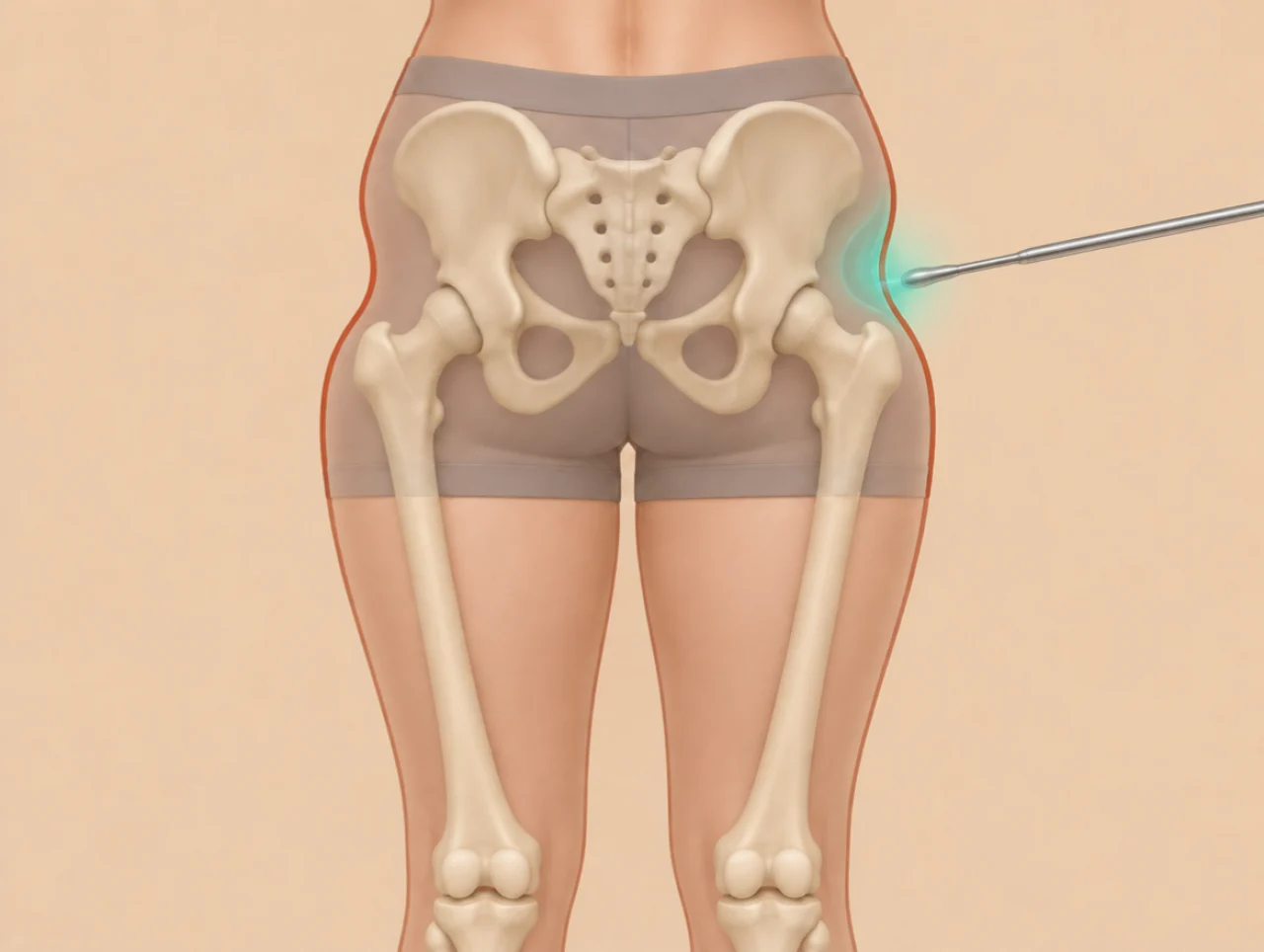
If you are planning hip dip filler in Korea from abroad, the first decision is not which clinic or which product — it is whether filler is the right tool for your hip dips at all, and how much would be needed. Hip dip filler is an injection of body filler into the inward curve on the side of the hips, between the pelvis and the thigh, to smooth out the outline; in Korean it is usually called "pelvic filler" (golban filler), and it also goes by hip filler or buttock filler. Three things shape the plan: hip dips are mostly a normal body shape that comes from your bones, body filler uses far larger amounts than facial filler (which is what drives the price), and neither the US FDA nor Korea's MFDS has approved any filler for increasing the size of the buttocks. Swelling and lumpy contours take days to weeks to settle, and you will sit on a long flight home, so the days you stay in Seoul matter as much as the product.
Hip dip filler in Korea at a glance
- Filler or fat transfer: for filling a local curve like hip dips, filler can have the edge; fat transfer is surgery and should go only under the skin, never into muscle
- How many cc: in our practice, usually up to about 100–300 cc for both sides combined; it varies a lot, so it is set at consultation
- Days to stay: swelling, bruising and pain usually settle within two to seven days, and lumpy contours over two to four weeks — get it done early in the trip, not right before your flight
- Price in Seoul: priced by the cc; about ₩1–3.2 million as an event price for 100 cc and about ₩2.8–4.4 million for 200 cc (market ranges, November 2026)
- How long it lasts: hyaluronic acid is absorbed gradually; in our practice some people keep the shape for three to four years or more, others top up after about a year
- Approval and risks: no filler is approved for buttock volume (FDA, MFDS); late inflammation or infection, lumps, migration and blocked vessels are rare but real
Not sure this one fits your skin? Start from your concern and see which treatments match.
Find by concernHip dip filler in Korea: filler, fat transfer or neither?
Before comparing clinics in Seoul, decide whether your hip dips need filling at all, and with what. Hip dips are mostly bone shape and nothing to worry about medically, so leaving them alone is a perfectly good choice. If you do want the curve filled, the two main options are hyaluronic acid filler and fat transfer. Fat transfer is surgery that takes fat by liposuction from the thighs or belly and moves it to the hips; fat placed under the skin is commonly used to correct hip dips (trochanteric depressions) and flat buttocks.
| Hyaluronic acid hip dip filler | Fat transfer to the hips | |
|---|---|---|
| Method | injection through a cannula | liposuction + injection (surgery) |
| What stays | about a third left after one year, about a quarter after two | what survives stays; about two thirds still there at 6 months in one study |
| Evidence | mostly small groups with short follow-up | by far the most experience |
| Main risks | rarely infection, migration, blocked vessels | rarely fatal pulmonary fat embolism when injected into muscle |
| Approval | no filler approved for buttock volume (FDA, MFDS) | surgery performed by a doctor |
- The big risk with fat transfer (BBL): when fat is injected deep into muscle, it can, rarely, cause a fatal pulmonary fat embolism. Vessels inside the muscle are larger and denser than those under the skin, and the depth, the technique and the amount of fat all play a part.
- The risk has come down: once surgeons stopped injecting into muscle, the death rate fell sharply; it is now put at about 1 in 15,000, similar to a tummy tuck. Complications are lowest when fat goes only under the skin, or is placed under ultrasound guidance.
- Other risks: minor problems such as fluid collection (seroma) or uneven contours happen in roughly 1 in 50 people, and hypothermia, sepsis and skin necrosis occur rarely. Risk is higher in poorly regulated facilities and with medical tourism.
- The difference we see in practice: if you only want more overall buttock volume, both fat transfer and filler can work. But for the hip and pelvic line shaped by the skeleton, and hip dips in particular, where a local curve has to be filled and held, filler is the better option in our view.
- When filler alone falls short: body contouring sometimes needs removing volume (liposuction) as well as adding it, so filler alone may not give you the shape you want.
How many cc of hip dip filler do you need?
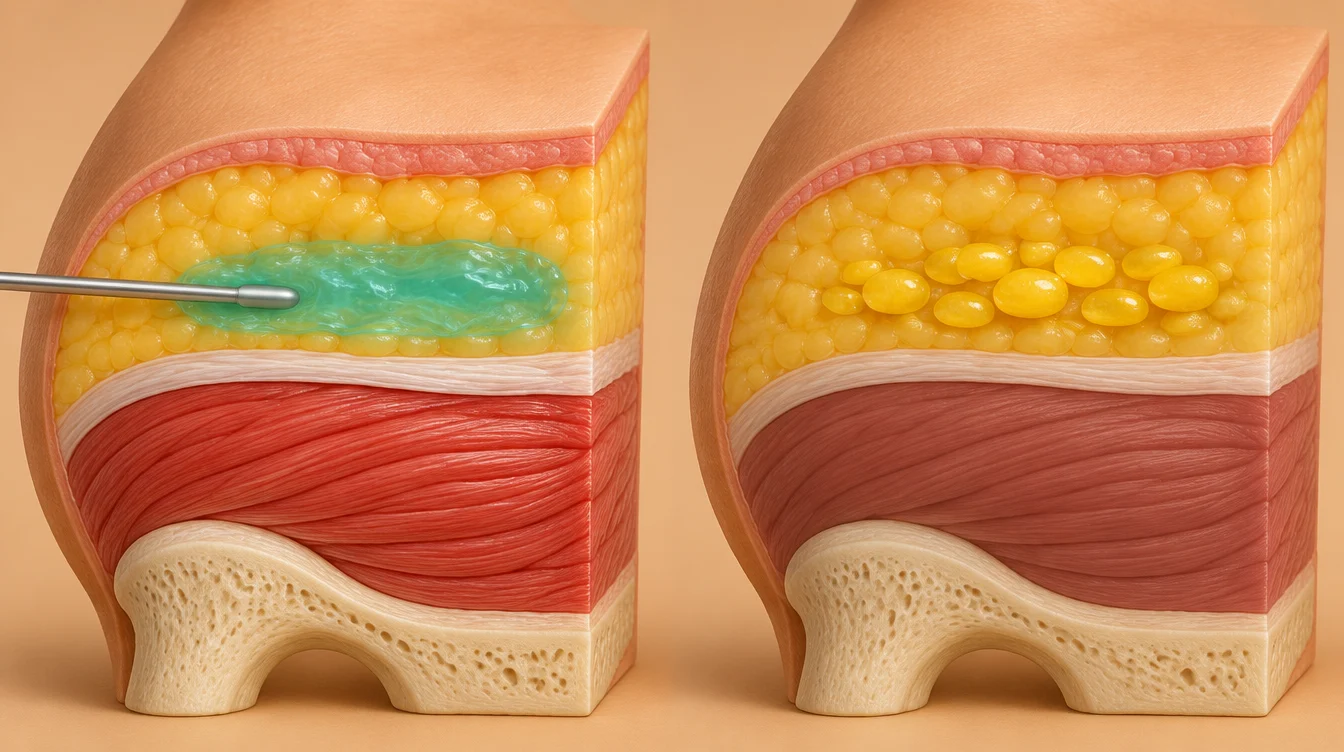
The amount depends mostly on whether only the hip dips are filled or the whole buttock is enlarged.
| Case | Amount |
|---|---|
| Hip dips only | 10 mL per side per session, one more session after 15 days if needed |
| Buttock volume ① | up to 60 mL, mean 43.6 mL |
| Buttock volume ② | up to 100 mL, mean 40.4 mL |
| Buttock volume ③ | mean 85.1 mL |
| Buttock volume (a Korean clinic) | 200–360 mL in total |
| Buttock volume (followed by MRI) | mean 163 mL per buttock |
- How much bigger: about 40 mL on average adds roughly 1–2 cm to buttock circumference right after.
- More volume, more material: some clinics inject several hundred mL, but the more you inject, the higher the cost and the more foreign material goes into your body. Hyaluronic acid in the blood rises briefly for about a month and is generally back to normal by about three months.
The amount is also what mostly decides the price. In our practice, the total for both sides usually goes up to about 100–300 cc. Bone shape, fat thickness and the shape you want make a big difference, so the amount is decided at an in-person consultation.
Planning hip dip filler in Seoul: days, flights and records
Not sure whether your hip dips are bone shape, or whether filler or fat transfer suits you? Ask us before you book your trip.
Ask on WhatsAppHip dip filler shows straight away, but swelling, tenderness and lumpy contours take time to settle — and the buttocks take your weight on the flight home. Plan the trip around that window.
- How many days to stay: swelling, bruising, pain and redness usually settle within two to seven days, and in our practice lumpy contours usually settle over two to four weeks, sometimes longer. Ask the clinic how many days to stay and when you can sit for long periods; avoid booking treatment for the day before a long-haul flight.
- Get it done early in the trip. Early treatment leaves time to go back to the same clinic for a check before you leave. If some unevenness remains because the volume was not quite enough, a top-up is discussed.
- Sitting, lying down and exercise: when you can sit, lie on your side or exercise again depends on the amount and placement, so follow the clinic's aftercare.
- Some reactions show after you are home. Late reactions to hyaluronic acid filler usually appear three to four months after treatment. The warning signs under side effects apply wherever you are — see a doctor locally and show them your record.
- What to take home: ask for the product name, the amount (cc) and the layer in writing. It helps if you top up later, and it helps a doctor at home if swelling, a lump or an infection appears after you return.
- Language: for foreign patients, the consultation and aftercare are explained through an interpreter, so ask anything you are unsure about before treatment, not after you fly home.
Hip dip filler before and after: swelling, pain and lumps
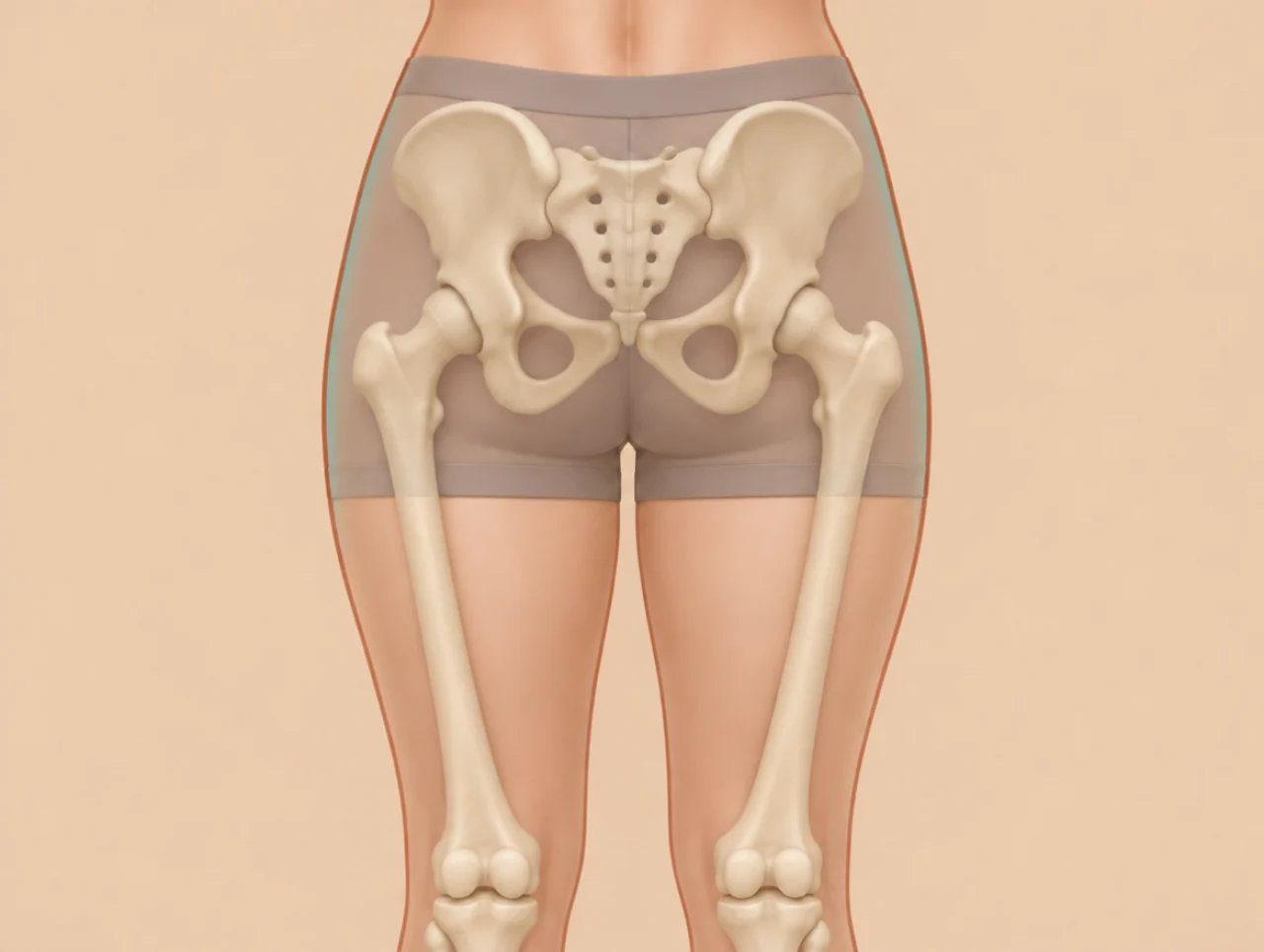
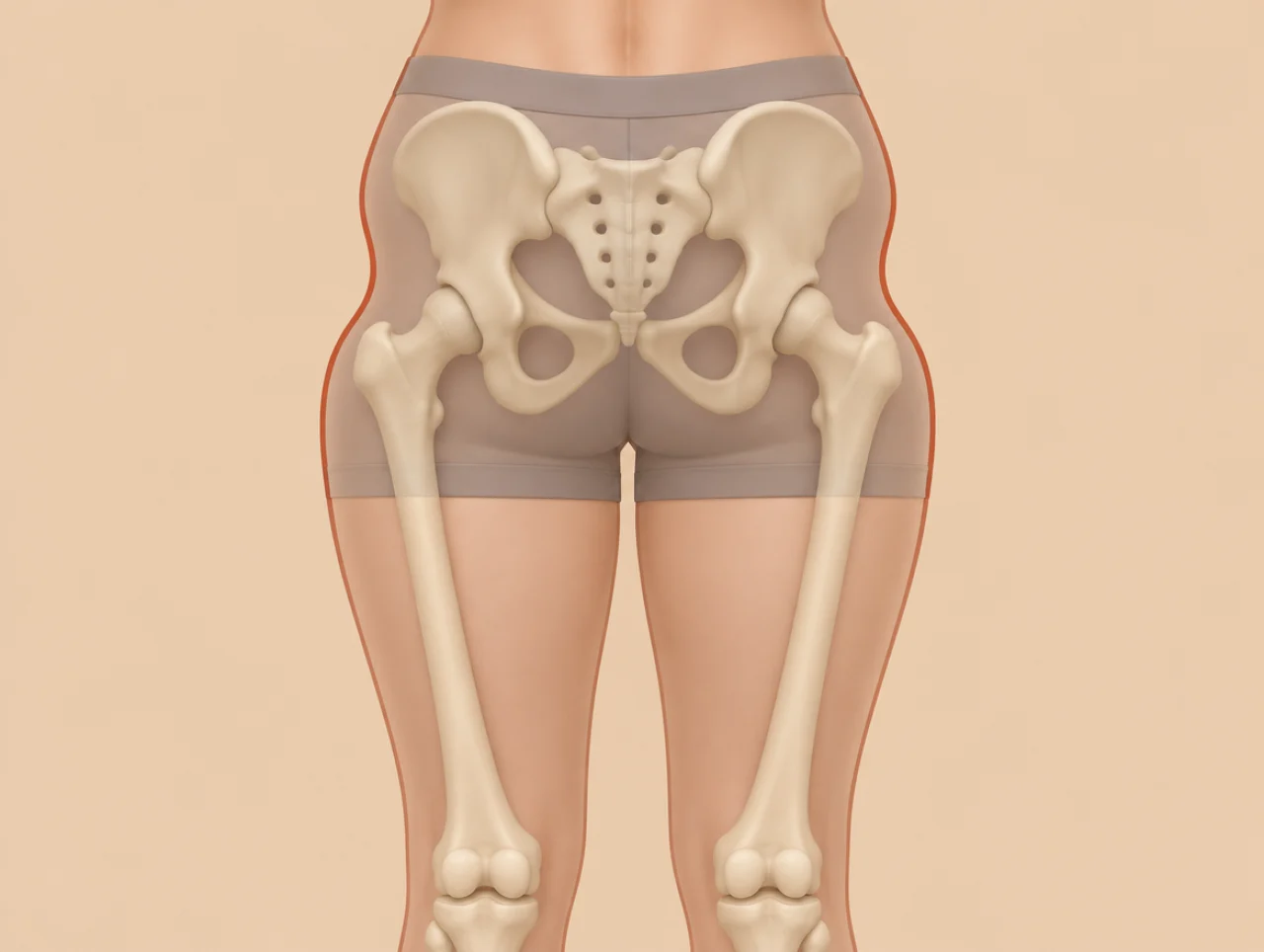 BeforeA few weeks later
That comparison is a 3D model, not a patient photo. When you look at case photos from clinics in Seoul, check whether they were taken right after treatment (when swelling adds volume) or weeks later, in the same light, pose and angle, and how many cc were injected. Each case is individual, not a promise of your result.
The most common reactions are swelling, bruising, pain and redness.
- How long: they are mostly mild or moderate and settle within two to seven days. When only the hip dips are filled, mild bruising and pain usually last two to three days.
- How common: in one study about 1 in 5 people had mild reactions such as swelling, bruising or temporary firmness, which went away on their own.
- Sitting: the buttocks carry your weight when you sit. When you can sit, lie on your side or exercise again depends on the amount and placement, so follow the clinic's aftercare.
In our practice, some swelling is unavoidable, and contours you can feel or see as lumpy usually settle over two to four weeks, sometimes longer. If some unevenness remains because the volume was not quite enough, a top-up injection is discussed.
Recovery timeline
Right after
Swelling, bruising and tenderness are common. Follow the clinic's advice on sitting, lying down and exercise
2–7 days
Swelling, bruising, pain and redness usually settle by now
2–4 weeks
Lumpy contours gradually settle; for some people it takes longer
Months to a year+
Hyaluronic acid is absorbed gradually. If volume is short, a top-up is discussed
Hip dip filler price in Korea: what decides the cost
Typical prices in Seoul
Hip dip filler is not covered by Korean health insurance, so there is no official price statistic. These ranges come from public price lists on Korean price-comparison platforms (Modoodoc, Goodoc, unni.app) and clinic price pages, checked in November 2026. Body filler listings are far fewer than face filler listings, and the "usual" prices shown next to event prices vary a lot, so the ranges are wide.
| Usual (listed) price | Event / first-visit price | |
|---|---|---|
| Body filler for hips / hip dips, 1cc | about ₩30,000–150,000 | often about ₩20,000–66,000 |
| Hip dip filler, 100 cc | often about ₩3–6 million (some listings much higher) | about ₩1–3.2 million |
| Hip dip filler, 200 cc | about ₩4.3–5.3 million | about ₩2.8–4.4 million |
- Price follows the amount: body filler is priced per cc or in 100 cc / 200 cc bundles, and hip dips usually need tens to hundreds of cc, so the total depends on how many cc you need far more than on the per-cc price on a menu.
- What moves the price: the product (body-specific hyaluronic acid, Korean-made or imported, or a collagen-type product), the amount, the doctor's experience, and whether anaesthesia, check visits and aftercare are included.
- Check VAT: some prices are listed without the 10% VAT; most platform listings showed prices with VAT included.
- Very cheap prices: compare the product name and the number of cc first; a lower total often means less product or a different material. Ask what the product is approved for.
Prices at a BeautyCoordi partner clinic
BeautyCoordi's partner clinic near Konkuk University station in Seoul listed these hip dip filler prices on 13 November 2026, in Korean won:
| Treatment (clinic menu name) | Price (KRW) |
|---|---|
| Hip dip filler (골반필러/힙딥필러), 1cc | 70,000 (first-visit / event price 39,000–49,000) |
| Hip dip filler, 100 cc | 3,000,000 |
| Hip dip filler, 100 cc + 100 cc | event price 3,490,000 |
| Hip dip filler, 200 cc | 5,500,000 |
| Collagen hip dip filler (콜라겐 힙딥 골반필러), 200 cc | 7,500,000 |
Some of these are first-visit or limited-time prices, so check what is on now before you book. See current events →
Prices are for one session, and anything you add on the day costs extra. The amount you need is set at consultation.
Tell us what matters most to you — value, location, expertise, premium products, language or budget — and we will recommend clinics in Korea that fit: we collect your request first and match you with several options.
Current events
Prices in KRW, VAT not included. Items and prices may change. Disclosure
How to choose a hip dip filler clinic in Korea: a checklist
There is no official ranking of hip dip filler clinics in Korea. Offers for the same "100 cc" differ because the conditions differ, so compare clinics on these points instead.
- Which product: ask for the product name and what it is approved for, and check the label and package insert. Is it a body-specific hyaluronic acid, PLLA, or a non-absorbable material such as polyacrylamide or liquid silicone (see the risks below)?
- How many cc, in which layer: body filler usually goes into the subcutaneous fat layer through a blunt cannula. Ask how many cc are planned for each side and whether it is done in one session or split.
- Where and by whom: get it from a doctor experienced in injections. Serious complications happen most often with illegal injections by unqualified people, and the embolism case under side effects happened at a non-medical beauty facility.
- Expectations: talk through the result you expect with the doctor and don't decide on impulse. Go over in advance that hyaluronic acid is absorbed and needs repeating, and that a hip dip made by bone shape may not become completely flat.
- Aftercare for a visitor: whether a check visit before your departure is possible, who to contact after you fly home, and whether you get the product, amount and layer in writing.
Is hip dip filler FDA approved?
- US FDA: the FDA advises against using fillers for body contouring, such as increasing the size of the buttocks, and has not approved these uses. Injectable silicone is not approved for any cosmetic use.
- Korea's MFDS: cosmetic fillers are mainly approved for facial wrinkles and facial volume. Volume enhancement of body areas such as the buttocks and calves is not an approved purpose, and no product is approved for it. Approved uses can be checked product by product in the MFDS medical device database.
- Sculptra (PLLA) and calcium hydroxylapatite: body use of these collagen-stimulating fillers, including the buttocks, is mostly off-label. PLLA is approved for facial aesthetics.
Off-label does not automatically mean illegal or dangerous, but it does mean the product's effect and safety for that use were not checked in its approval review. Ask which product will be used and what it is approved for.
How long does hip dip filler last? Is it permanent?
No — hyaluronic acid is broken down and absorbed gradually. That is why the shape is fullest right after treatment and shrinks over the following months.
- How much stays: measured by MRI, a little over half the gel remains at 6 months, about a third at one year and about a quarter at two years. Even so, about 6 in 10 people still felt their buttocks looked better at two years.
- Satisfaction over time: in another study, satisfaction went from 9 in 10 at one month to about 6 in 10 at one year, in line with the hyaluronic acid breaking down.
- Repeat treatment: so to keep the result, you need to top up from time to time.
- Sculptra (PLLA) changes differently: it thickens tissue over weeks rather than filling at once; results have been followed for nine months after three sessions a month apart.
In our practice, some people keep the shape for three to four years or longer, while others come back for a top-up after about a year. It depends on the amount, the product and changes in your body.
Hip dip filler side effects: necrosis, infection, lumps and migration
No treatment is free of side effects. Serious problems have been rare so far, but most results come from small groups followed for six to twelve months, which is too little to catch rare complications. Known filler side effects include itching, inflammation and pain, bruising and swelling, skin necrosis, blindness or reduced vision, leakage of the injected material, migration to unintended areas, and temporary or long-lasting nodules.
- Late inflammation or infection: late reactions to hyaluronic acid filler usually appear three to four months after treatment. The filler's properties, bacteria introduced during treatment or a hidden biofilm, and the body's immune response are thought to be behind them. Non-infectious reactions are treated by dissolving the filler with hyaluronidase, but if it is an infection, drainage, culture and antibiotics come before the enzyme.
- Does hip dip filler migrate? Hyaluronic acid injected into the buttocks has been known to move to the inner thigh and show up as a soft lump. This is very rare.
- Blocked vessels and necrosis: if filler enters a blood vessel it can block it and cause skin necrosis. There has also been a case of a woman who had buttock hyaluronic acid injections at a non-medical beauty facility and within hours became drowsy and short of oxygen, with lung and brain problems.
- Large volumes and imaging: after large-volume hyaluronic acid gel in the breasts, there have been lumps, infection and fibrosis, and the remaining gel made the tissue hard to see on imaging, so it is generally not recommended there. The buttocks are a different area, but large amounts of remaining filler can show up on imaging.
- Non-absorbable materials: there is a case of abscesses running from the buttocks to the calves after polyacrylamide filler that needed surgery, and injectable silicone can cause long-lasting pain, infection and serious injury.
- If something goes wrong: ultrasound can tell which filler is in the buttocks and where, and catch complications early. A written record of the product, the amount and the layer makes it much easier for any doctor to help.
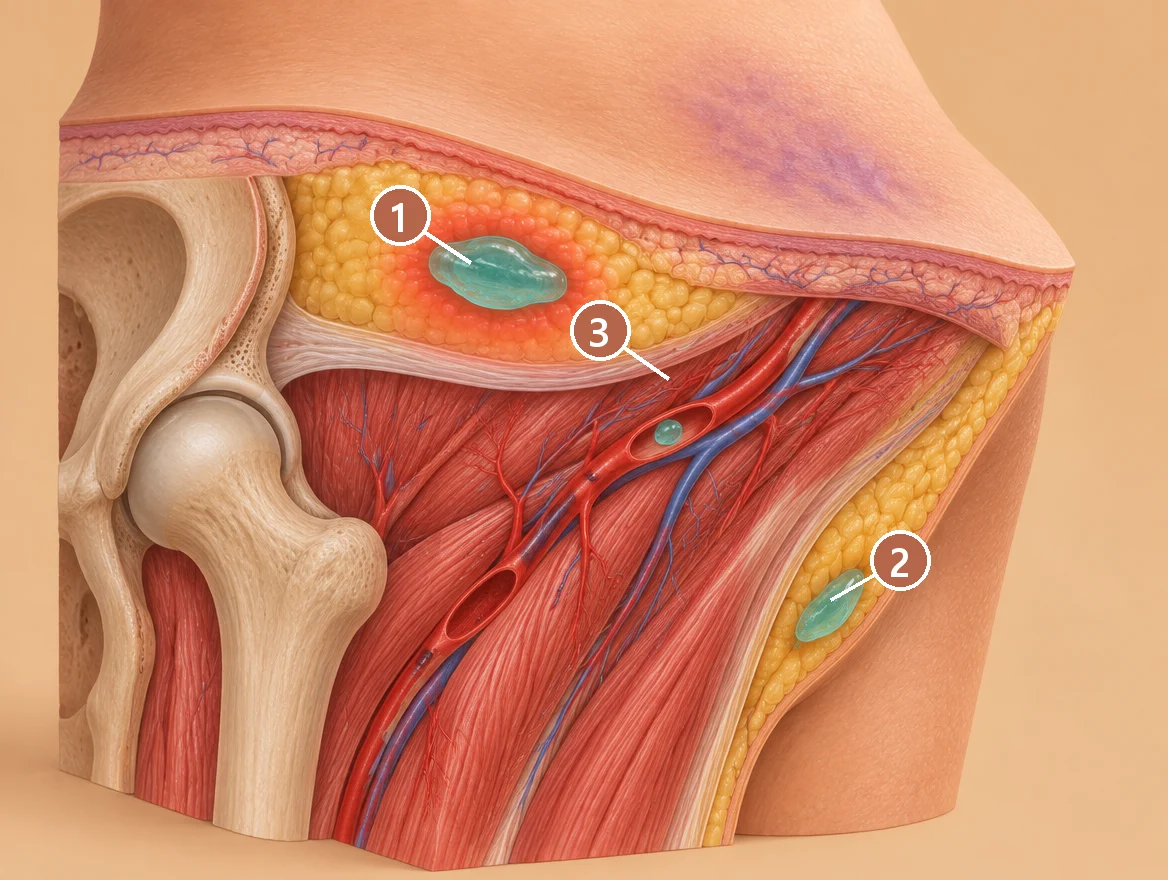
Get medical care right away if
- the skin over the treated area turns white, or blotchy purple or dark red, and the pain keeps getting worse
- days or months later the area swells again, feels hot and red, or you get a fever
- pus comes out, or a lump grows and hurts
- you become short of breath, have chest pain or feel confused after treatment (go to the emergency room)
What causes hip dips?
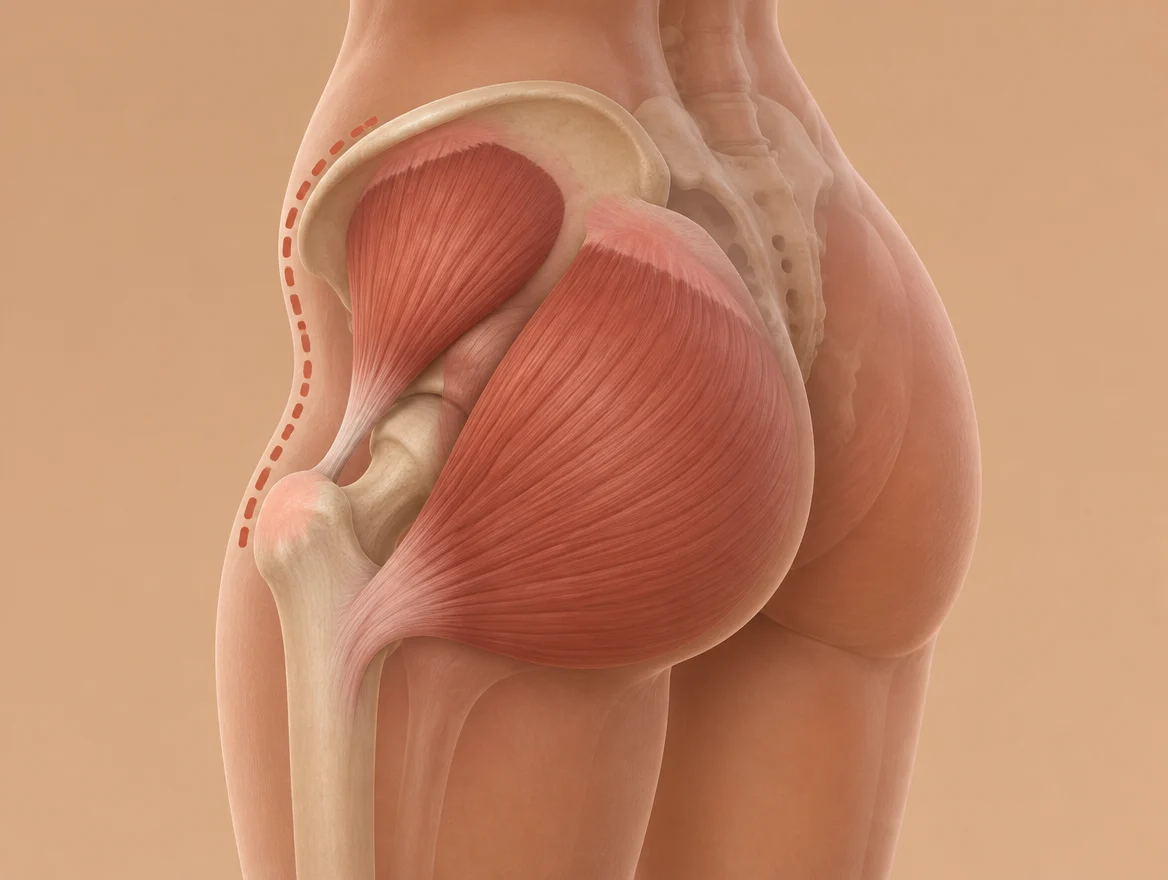
Hip dips are an inward curve on the side of the body between the hip and the thigh. The term came from social media — it is not a medical diagnosis.
- Two curves made by bone: the top of the pelvic bone (ilium) makes the first rounded line of the hips, and the femoral neck with the bony bump on the outside of the thigh bone — the greater trochanter — makes the second. The hollow left between those two curves is the hip dip. How deep it is depends on pelvic width, femoral neck length and the size of the greater trochanter.
- Muscle and fat: muscle mass and fat distribution can make hip dips stand out more, but they are not the cause. Exercise-shaped muscle contours or ageing can also make the hollow look deeper.
- What surrounds it: the dip sits below the greater trochanter, framed by the attachments of the gluteus medius, vastus lateralis, quadratus femoris and gluteus maximus, in an area with few ligaments holding the skin firmly.
- Is it a health problem? Hip dips are very common and nothing to worry about. Treating them is purely a choice about shape.
Can you fix hip dips with exercise?
Because hip dips come from bone shape, losing weight or building muscle will not "fix" them. Glute exercises can make the hollow look a little fuller, but they will not make it disappear.
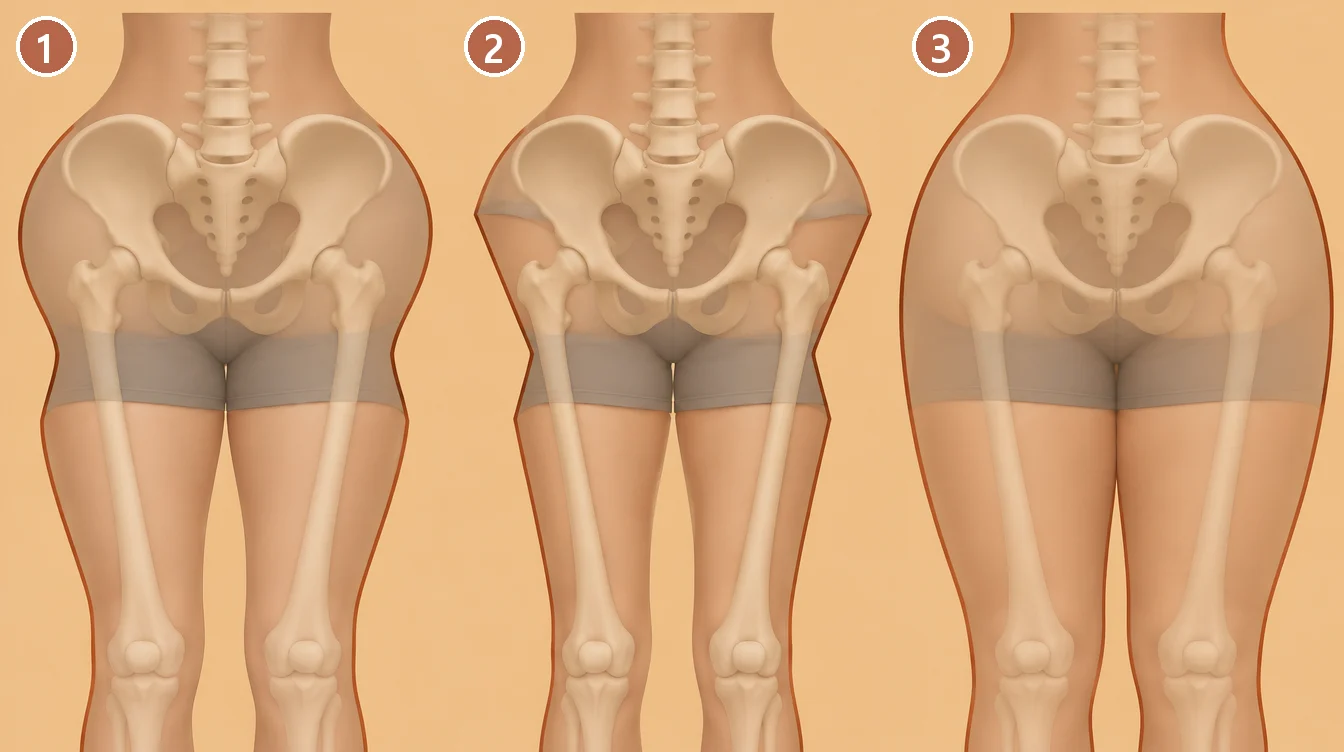
What is hip dip filler? Hyaluronic acid, Sculptra (PLLA) or fat
| Material | How it fills | What is known |
|---|---|---|
| Hyaluronic acid body filler | fills straight away with the gel's own volume; body products are firmer and have larger particles than facial ones | mostly small groups with short follow-up; absorbed gradually, so it needs repeating |
| PLLA (Sculptra, a collagen-stimulating injection) | thickens the dermis and fat layer over several weeks rather than filling at once; several sessions a month apart | still few results for hip dips; body use is off-label |
| Your own fat (fat transfer) | fat taken by liposuction elsewhere is moved to the hips | by far the most experience; what survives stays; injecting into muscle carries a risk of fat embolism |
| Polyacrylamide, liquid silicone and similar | non-absorbable materials | cases of abscesses and severe injury; the FDA has not approved injectable silicone for any cosmetic use |
- Body hyaluronic acid is not facial filler: body filler has to fill larger volumes and take more pressure when you sit and move, and firmness (elasticity) varies widely between products, so the product has to suit the area. For hip dips, a firm, large-particle body product is usually placed in the middle layer of the subcutaneous fat.
- Sculptra (PLLA) for hip dips: when PLLA was injected on one side only, three times a month apart, only that side's dermis and fat layer thickened, by about a quarter. Off the face, the buttocks and hip dips are the most common PLLA areas; bruising happens in about 1 in 20 people and nodules are uncommon.
- The evidence is still thin: among ways to enlarge the buttocks, hyaluronic acid injection has very little experience behind it. It seems to work, but it is temporary and expensive, and many doctors say it is not as simple and harmless as advertised. Keep in mind that many of the results were supported by manufacturers or importers, or involved company staff.
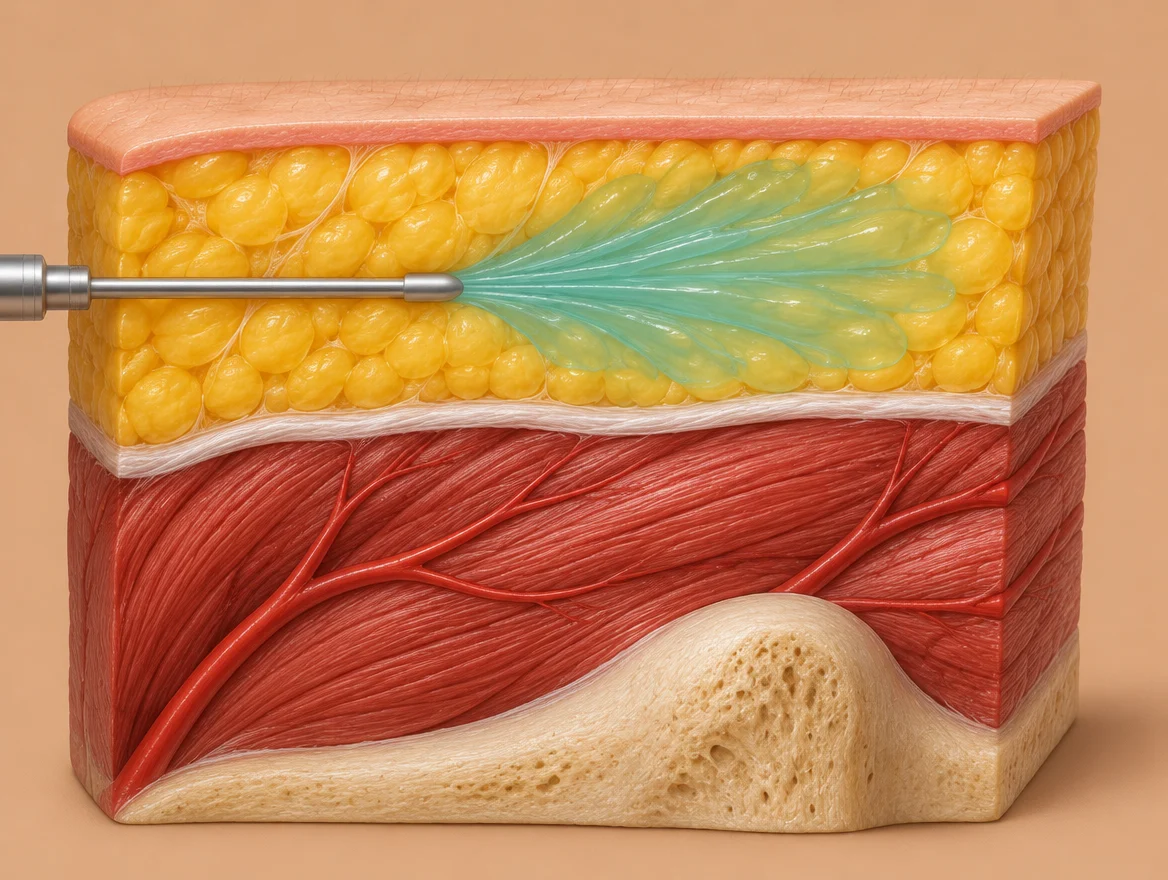
FAQ
How much is hip dip filler in Korea?
It is priced by the cc. On Korean price platforms in November 2026, event prices were about ₩1–3.2 million for 100 cc and about ₩2.8–4.4 million for 200 cc, and listed usual prices were higher. Because hip dips usually need tens to hundreds of cc, the total depends mostly on the amount; compare the product and the cc, not just the headline price.
How many days should I stay in Seoul after hip dip filler?
Swelling, bruising and pain usually settle within two to seven days, and lumpy contours over two to four weeks. Get it done early in your trip so you can go back for a check, ask the clinic when you can sit for long periods, and avoid treatment right before a long flight.
Are hip dip filler, hip filler and buttock filler different procedures?
The names are mixed for the same kind of procedure. Hip dip filler usually means filling only the hollow on the side of the hips, while buttock filler usually means enlarging the whole buttock, and the amount injected differs a lot.
How many cc or ml of filler do hip dips need?
In our practice, the total for both sides usually goes up to about 100–300 cc (1 cc is 1 mL). Bone shape and the shape you want make a big difference, so it is set at consultation.
Can hip dip filler be dissolved?
Hyaluronic acid filler can be dissolved with an enzyme (hyaluronidase). But when infection is suspected, drainage, culture and antibiotics come before dissolving. PLLA and non-absorbable materials do not dissolve with the enzyme.
Can exercise get rid of hip dips?
Hip dips come from bone shape, so exercise and weight loss will not "fix" them. Glute exercises can make them a little less visible.
How long do hip dip fillers last?
Hyaluronic acid is absorbed gradually. About a third of the gel is left after one year and a quarter after two, and satisfaction drops from about 9 in 10 to 6 in 10 within a year. In our practice, some people keep the shape for three to four years or more and others top up after about a year — it depends on the amount, the product and the person.
Is hip dip filler safer than fat transfer?
It is hard to compare them head to head. Fat transfer has far more experience behind it and its risk fell sharply once injecting into muscle was avoided, but it is surgery. Hip dip filler is an injection, but no product is approved for that use and what is known comes from small, short studies. Decide with a doctor based on your body and the change you want.
Can I sit down right after hip dip filler?
It depends on the amount and placement, so follow the clinic's aftercare. Swelling and pain usually settle within two to seven days.
Sources
- Cleveland Clinic Health Essentials. Hip Dips — Your bone structure determines whether you have a visible dent between your hips and your thighs, 2024
- Lourenco L et al. Hip dips technique — Filling lateral depressions with hyaluronic acid of large particles. Skin Health Dis, 2024
- Fontenete S, Alfertshofer M. Rheological and Physicochemical Properties of Hyaluronic Acid Fillers for Body Contouring. J Cosmet Dermatol, 2026
- Hur JH et al. Clinical Evaluation of Hyaluronic Acid Filler for Gluteal Augmentation — A Retrospective Study. Plast Reconstr Surg Glob Open, 2026
- Bussade M et al. Assessment of Hyaluronic Acid Filler in Gluteal Augmentation and Contouring — A 1-Year Prospective Study. J Cosmet Dermatol, 2025
Show 27 more sources
- Iribarren-Moreno R et al. Hyaluronic Acid Gluteal Augmentation — New Marking and Application Technique. Plast Reconstr Surg Glob Open, 2025
- Crabai P et al. Evaluating the Safety and Satisfaction of HYAcorp MLF2 for Noninvasive Buttock Augmentation — A Multicenter Study. Plast Reconstr Surg Glob Open, 2025
- Camenisch CC et al. Macrolane for volume restoration and contouring of the buttocks — magnetic resonance imaging study on localization and degradation. Plast Reconstr Surg, 2013
- Claude O et al. Treatment of HIV-Infected Subjects with Buttock Lipoatrophy Using Stabilized Hyaluronic Acid Gel. Plast Reconstr Surg Glob Open, 2015
- Oranges CM et al. Gluteal Augmentation Techniques — A Comprehensive Literature Review. Aesthet Surg J, 2017
- Atiyeh B et al. Safety and Efficiency of Minimally Invasive Buttock Augmentation — A Review. Aesthetic Plast Surg, 2023
- Korea Ministry of Food and Drug Safety (MFDS), via Korea.kr policy briefing. Precautions for cosmetic filler procedures, 2019
- Korea Ministry of Food and Drug Safety (MFDS), Medical Device Information Portal. Product search — tissue-repair biomaterials
- U.S. FDA. Dermal Fillers (Soft Tissue Fillers), content current as of 2023-07-06
- Butterwick KJ et al. The FDA-Approved and Non-FDA-Approved Indications for Biostimulatory Fillers off the Face. Dermatol Surg, 2026
- Haddad A et al. Injectable Poly-L-Lactic Acid for Body Aesthetic Treatments — An International Consensus on Evidence Assessment and Practical Recommendations. Aesthetic Plast Surg, 2025
- Zubair R et al. SPLASH — Split-Body Randomized Clinical Trial of Poly-L-Lactic Acid for Adipogenesis and Volumization of the Hip Dell. Dermatol Surg, 2024
- Durairaj KK et al. Nonfacial Use of Injectable Poly-L-lactic Acid — Safety Data From a Multicenter Observational Study in the United States. Aesthet Surg J Open Forum, 2026
- Baranska-Rybak W et al. Late-Onset Reactions after Hyaluronic Acid Dermal Fillers — A Consensus Recommendation on Etiology, Prevention and Management. Dermatol Ther (Heidelb), 2024
- Saad A et al. A Rare Case of Migration of Hyaluronic Acid Gluteal Injection to the Medial Thigh Presenting as a Soft Lump. Indian J Radiol Imaging, 2023
- Uz İ et al. Fat embolism syndrome after gluteal augmentation with hyaluronic acid — A case report. Ulus Travma Acil Cerrahi Derg, 2020
- Becchere MP et al. A case series study on complications after breast augmentation with Macrolane. Aesthetic Plast Surg, 2013
- Wünscher SV et al. Long-term Complications of Gluteal Augmentation Using Aquafilling Filler — A Case Report. Indian J Plast Surg, 2023
- Ducati EPJ et al. Reviewing the Ultrasound Anatomy of the Gluteal Region and the Mapping of Fillers. J Cosmet Dermatol, 2025
- Mofid MM et al. Report on Mortality from Gluteal Fat Grafting — Recommendations from the ASERF Task Force. Aesthet Surg J, 2017
- Rios L, Gupta V. Improvement in Brazilian Butt Lift (BBL) Safety With the Current Recommendations from ASERF, ASAPS, and ISAPS. Aesthet Surg J, 2020
- Tillo O et al. The British Association of Aesthetic Plastic Surgeons (BAAPS) Gluteal Fat Grafting Safety Review and Recommendations. Aesthet Surg J, 2023
- Elsaftawy A et al. Gluteal Augmentation with Fat Grafting — A Systematic Review and Meta-Analysis of Complications and Procedural Factors. Plast Reconstr Surg, 2026
- Seabra Robalo Gomes Jorge AC et al. Danger Zones of the Gluteal Anatomy — Improving the Safety Profile of the Gluteal Fat Grafting. Aesthetic Plast Surg, 2024
- Aad S et al. Fatal fat embolism in cosmetic surgery — Comparing gluteal fat grafting to other lipofilling procedures. JPRAS Open, 2026
- Cansancao AL et al. Subcutaneous-Only Gluteal Fat Grafting — A Prospective Study of the Long-Term Results with Ultrasound Analysis. Plast Reconstr Surg, 2019
- Wang B et al. B-ultrasound-assisted gluteal fat grafting in Asians — A prospective study of quantitative results from three-dimensional imaging and B-ultrasound analysis. J Plast Reconstr Aesthet Surg, 2024
Dr. Park HwonhamDR.BAQUOPPEUM Clinic Konkuk Univ.Contents · 12
- 01Hip dip filler in Korea: filler, fat transfer or neither?
- 02How many cc of hip dip filler do you need?
- 03Planning hip dip filler in Seoul: days, flights and records
- 04Hip dip filler before and after: swelling, pain and lumps
- 05Hip dip filler price in Korea: what decides the cost
- 06How to choose a hip dip filler clinic in Korea: a checklist
- 07Is hip dip filler FDA approved?
- 08How long does hip dip filler last? Is it permanent?
- 09Hip dip filler side effects: necrosis, infection, lumps and migration
- 10What causes hip dips?
- 11What is hip dip filler? Hyaluronic acid, Sculptra (PLLA) or fat
- 12FAQ

Free consultation
Not sure this fits your skin?
Send your concern and budget on WhatsApp and get a free answer before you book.
Photo shows an AI-generated model.
More in this section


This page is general information, not medical advice. Decide on any treatment after consulting a medical professional.