Treatments
Salivary Gland Botox vs Masseter Botox · Parotid & Submandibular
Written by BeautyCoordi Editorial TeamMedically reviewed by Dr. Park HwonhamDR.BAQUO11 min read
Contents · 8
- 01Salivary gland botox vs masseter botox
- 02Is it your salivary glands, muscle, fat or sagging?
- 03How salivary gland botox works: parotid vs submandibular
- 04Before and after: when it shows and how long it lasts
- 05Salivary gland botox side effects: dry mouth and trouble swallowing
- 06How it is done, and why ultrasound matters
- 07Salivary gland botox on a trip to Korea
- 08Frequently asked questions
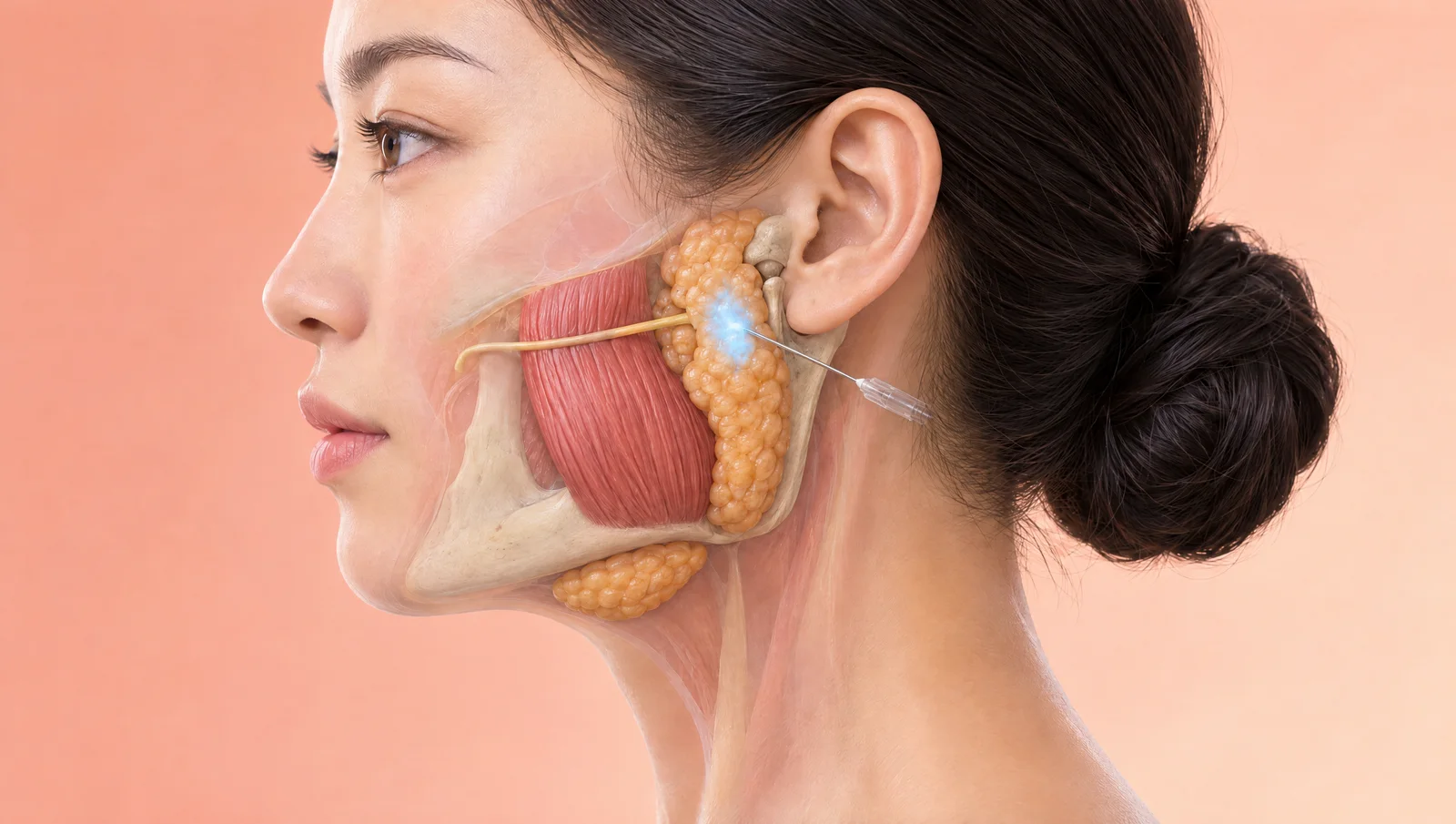
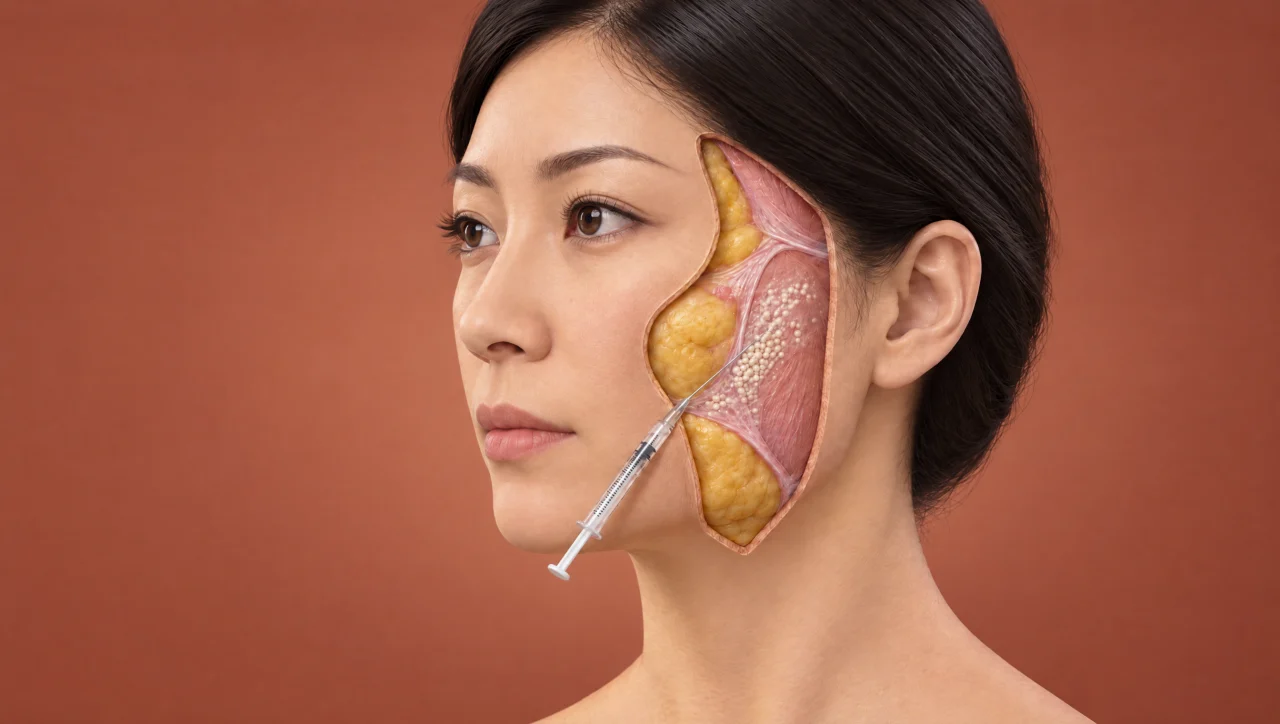
Salivary gland botox and masseter (jaw) botox use the same drug but aim at different things. Masseter botox shrinks the chewing muscle at the corner of the jaw; salivary gland botox goes into the parotid glands below the ears or the submandibular glands under the jawbone, to reduce the volume of the saliva-making tissue that can make a jawline look wide or blurred. It only makes sense when a gland is what actually stands out — and in Korea, no toxin product is approved for the salivary glands, so cosmetic gland injections are off-label, at the doctor's judgement.
Salivary gland botox: the short answers
- Salivary gland botox vs masseter botox: the masseter hardens when you clench your teeth; the parotid gland does not. When both cause the width, both are sometimes treated
- Who salivary gland botox may suit: a soft bulge below the ear, or a separate lump under the jawbone, that does not harden when you clench
- Who may not need it: if your glands do not stand out, it brings little change and can cause dry mouth instead
- Salivary gland botox before and after: in studies, parotid volume and thickness fell and most of the reduction was still there at three months
- How long does salivary gland botox last? Data on how long cosmetic results last is still limited
- Salivary gland botox side effects: dry mouth and, rarely, difficulty swallowing. Other glands make up for the saliva, so a truly dry mouth is rare in practice
Not sure this one fits your skin? Start from your concern and see which treatments match.
Find by concernHow botox works in general, product differences and resistance are in the Korean botox guide. This page covers salivary gland botox only.
Salivary gland botox vs masseter botox
| Masseter (jaw) botox | Salivary gland botox | |
|---|---|---|
| Where it goes | the masseter (chewing muscle) | the parotid and/or submandibular glands |
| What it reduces | muscle volume | volume of saliva-making tissue |
| How it feels | hardens when you clench your teeth | does not harden when you clench |
| Korean MFDS approval | Nabota is approved for benign masseter hypertrophy | no product found with a salivary gland indication |
| Side effects to know | discomfort when chewing, hollow cheeks, facial asymmetry | dry mouth, rarely difficulty swallowing |
A 2026 review explained that the parotid does not harden when you clench, which tells it apart from the masseter, which does. The same review noted that when the side of the face still looks wide after masseter botox, the parotid may be the cause. The reverse is also true: if the width comes from the masseter, injecting only the glands changes little. When both contribute, both are sometimes treated — see the section on repeat sessions below for what to check about the combined dose.
Is it your salivary glands, muscle, fat or sagging?
A heavy-looking jawline can come from the salivary glands, the muscle, fat, sagging — or a mix. Salivary gland botox only matters when a gland actually stands out. In the consultation, these three signs come first:
| If it looks like this | Look first at | What fits |
|---|---|---|
| a firm, large bulge when you clench your back teeth | muscle (masseter) | masseter botox |
| a bulge below the earlobe even with your face relaxed | enlarged salivary gland | salivary gland botox |
| the whole jawline is not well defined | body fat | weight and fat management |
In more detail:
- Likely the glands: a soft swelling below the ear that does not harden when you clench (parotid), or a separate lump you can feel below the jawbone (submandibular)
- Likely the muscle: the corner of the jaw below the ear bulges firmly when you clench → masseter botox
- Likely fat: no separate gland can be felt and the whole area under the chin is full. Toxin reduces saliva-making tissue but does not reduce fat
- Likely sagging: fullness under the jaw that came with age. In an analysis of 100 CT scans, the submandibular gland descended below the jawbone by an average of 0.17 mm a year, while its volume did not change with age. It sagged rather than grew, so even if toxin reduces its volume, it cannot lift the gland
Body shape plays a part too. In an ultrasound study of 214 people, a higher BMI meant the submandibular gland sat deeper under the skin and further from the jawbone. That is why looking alone is often not enough, and a consultation includes feeling the area, asking you to clench, or checking with ultrasound.

 Before3 months
Not sure whether your jawline is glands, muscle or fat? Send us a question before you book your trip.
Ask on WhatsAppIf your glands do not stand out, salivary gland botox changes the jawline very little and can leave you with discomfort such as dry mouth as the glands work less. That is why the decision comes after checking whether a gland is really the cause.
How salivary gland botox works: parotid vs submandibular
Like muscles, salivary glands need a signal substance from the nerves (acetylcholine) to make saliva. When botulinum toxin blocks that signal, the saliva-making tissue works less, and over time the gland's volume shrinks. It is the same principle as treatment that reduces saliva in people with severe drooling from neurological conditions — in the US and Europe, Xeomin is approved for chronic drooling.
Two glands matter for the jawline:
| Gland | Where | How it shows on the jawline |
|---|---|---|
| Parotid gland | in front of and below the ear, above the jaw angle | the area below the earlobe looks swollen and the side of the face looks wide |
| Submandibular gland | under and inside the jawbone | fullness below the jawline blurs the border between jaw and neck |
What studies have found:
- Parotid: in a randomised study of 30 people who wanted a slimmer face, both treated groups had a significantly larger reduction in parotid volume than placebo, and only 4.8–7.6% of the volume came back after three months. In a study following 33 people with parotid hypertrophy for six months, parotid thickness fell and facial contour improved, and the severity of the hypertrophy affected the result.
- Submandibular: a German university hospital group that injected 23 people with bilateral submandibular hypertrophy under ultrasound reported no major complications over 18 months. There are no large comparative studies yet.
Before and after: when it shows and how long it lasts
Few studies have formally measured when cosmetic salivary gland botox starts to work and how long it lasts. A 2026 dosing review also called the cosmetic evidence for the glands limited. What has been measured so far:
| Study | Finding |
|---|---|
| Parotid randomised study (30 people) | 4.8–7.6% of the reduced volume came back after three months |
| Parotid hypertrophy prospective study (33 people) | thinner parotid at six months of follow-up |
| Drooling randomised study (184 people) | less saliva at week 4, effect lasting to week 16 |
The drooling study involved different patients, purposes and doses, so it cannot be read as the duration of a cosmetic result. How long it lasts varies a lot with the size of the gland, the amount injected and whether the toxin went precisely into the gland.
How often: in practice, about six months is usually seen as the cycle over which the effect wears off, and a three-month interval is sometimes recommended to reduce the glands' function more actively. The glands are not an approved site, so the approval information sets no interval for them. Even for approved areas, the MFDS approval information does not recommend frequent injections, and Xeomin's says frown-line treatments should be at least three months apart. Short intervals and high total doses are also named as resistance risk factors, so if you have jaw botox at the same time, check the combined amount and the interval for both areas with your doctor. Resistance is covered in the Korean botox guide.
Current events
Prices in KRW, VAT not included. Items and prices may change. Disclosure
Salivary gland botox side effects: dry mouth and trouble swallowing
No treatment is side-effect free. The ones to know for salivary gland botox:
- Dry mouth: the other salivary glands make up for it, so a truly dry mouth is very rare in practice. Still, about two-thirds of resting saliva comes from the submandibular glands, so a dry feeling can follow submandibular injections. The parotid makes saliva mainly when you eat, so dry mouth after parotid injections is considered rare. In drooling studies dry mouth was 2.7–5.4%, but those patients had too much saliva to begin with, so the figure cannot be applied to cosmetic treatment — and no study has yet measured dry mouth after cosmetic treatment.
- Difficulty swallowing: the submandibular gland sits close to the neck muscles used for swallowing, so toxin spreading outside the gland can make swallowing uncomfortable. In drooling studies it was 0–2.7%. In a Korean case report, a healthy 37-year-old woman who received 20 units of Xeomin into each submandibular gland without ultrasound developed severe difficulty swallowing the next day and recovered after five months of rehabilitation.
- Warnings in the approval information: Korea's MFDS approval information states that serious adverse events, including fatal outcomes, have been reported when toxin was injected into the salivary glands, the area around the mouth, tongue and throat, the oesophagus or the stomach. Some of those patients already had swallowing difficulty or weakness, and safety and efficacy in these areas have not been established.
- Common reactions: swelling, bruising or tenderness at the injection site. In the drooling meta-analysis, adverse events were mostly mild to moderate and resolved on their own.
Get medical care right away if
- swallowing water or food is hard, or you often choke when drinking
- your voice changes or your speech becomes slurred
- breathing is hard
If a very dry mouth or uncomfortable swallowing continues, do not wait it out — tell the clinic that treated you right away and get seen.
Tell the clinic first if swallowing is already uncomfortable or your mouth is often dry, you have had inflammation or stones in a salivary gland, you have a nerve or muscle disease such as myasthenia gravis, you are pregnant or breastfeeding, or you recently had botox in another area (jaw, forehead and so on) — whether to treat, and how much, may change.
How it is done, and why ultrasound matters
- Finding the cause: sitting up, the doctor feels the area and asks you to clench to tell glands, muscle and fat apart. The 2026 review noted that the submandibular gland can look less prominent lying down, so it is assessed upright where possible.
- Finding the position: gland size and depth differ between people. In the 214-person ultrasound study, the submandibular gland averaged 33.7 mm long, 13.3 mm thick and 27.6 mm high, and its depth varied with body shape.
- Injection: the toxin is placed inside the gland at several points. In a cadaver study, injections reached the submandibular gland accurately 50% of the time without ultrasound and 91.67% with ultrasound. For the parotid, the figures were 79.17% and 95.83%, a difference that was not statistically clear. The 2026 review regarded ultrasound as a basic safety measure for submandibular injections, though no clinical trial has yet compared results with and without it.
Keeping the toxin from spreading outside the gland is key to reducing dry mouth and swallowing problems, so ask at the consultation how the clinic confirms the position.
Salivary gland botox on a trip to Korea
- The consultation decides whether you need it. A gland that stands out is the reason to treat; if it does not, the treatment brings little change and can cause dry mouth. Expect the doctor to explain what is causing your jawline before you decide.
- Do not judge the result before your flight. Studies measured the change in gland volume at three and six months, and cosmetic data on when it starts is limited — the before and after is something you see over the following months, usually at home.
- Know the warning signs before you fly. In the Korean case report, severe swallowing difficulty began the day after the injection. If swallowing, speech or breathing becomes hard, get medical care right away wherever you are, and contact the clinic that treated you.
- Combined with jaw botox? Ask which glands were treated and how much was used, so the combined amount and the interval can be checked next time — in Seoul or at home.
- Mention recent botox at home. If you had botox in another area recently, tell the clinic before treatment.
Frequently asked questions
How many units are used for salivary gland botox?
There is no fixed number for cosmetic use. A 2026 dosing review said the evidence for cosmetic doses in the salivary glands is still limited and that glands should be assessed separately from muscles. The doses in drooling studies were for a different purpose and are not a guide for a jawline. The amount is decided after checking which gland is enlarged and how large it is — and if you also have jaw botox, the total for both areas matters.
Can I have salivary gland botox and masseter botox on the same day?
They are sometimes done together. Because the combined total dose goes up, check with your doctor that both areas really contribute to the width, and confirm the amount and interval.
Will my saliva stop completely?
No. There are many salivary glands besides the parotid and submandibular glands, and the treatment reduces the secretion and volume of only some of them. A dry feeling can follow submandibular injections, so tell the clinic beforehand if your mouth is often dry.
Does salivary gland botox reduce fat under the chin?
No. Toxin reduces saliva-making tissue but not fat. If the fullness under your chin is fat, other approaches are considered.
Sources
- Korea Ministry of Food and Drug Safety (MFDS), Drug Safety Nara. Nabota Inj. (Clostridium botulinum toxin type A) approval information — indications (benign masseter hypertrophy), precautions
- Korea Ministry of Food and Drug Safety (MFDS), Drug Safety Nara. Botox Inj. (Clostridium botulinum toxin type A) approval information — indications, injection into or near anatomically vulnerable structures
- Korea Ministry of Food and Drug Safety (MFDS), Drug Safety Nara. Xeomin Inj. (Clostridium botulinum toxin type A, 150 kDa) approval information
- Korea Ministry of Food and Drug Safety (MFDS), Drug Safety Nara. Botulax Inj. (Clostridium botulinum toxin type A) approval information
- Korea Ministry of Food and Drug Safety (MFDS), Drug Safety Nara. Coretox Inj. (Clostridium botulinum toxin type A, 150 kDa) approval information
Show 12 more sources
- Jost WH et al. Botulinum neurotoxin type A in the interdisciplinary treatment of sialorrhea in adults and children — update and practice recommendations. Front Neurol, 2023
- Jost WH et al. SIAXI — Placebo-controlled, randomized, double-blind study of incobotulinumtoxinA for sialorrhea. Neurology, 2019
- Yu YC et al. Efficacy and safety of botulinum toxin for treating sialorrhea — A systematic review and meta-analysis. Eur J Neurol, 2022
- Jeong WS et al. The Volumetric Effect of Botulinum Toxin Type A Injection on the Parotid Gland — A Randomized Controlled Trial. Plast Reconstr Surg, 2024
- Chen Z et al. Efficacy and Safety of Botulinum Toxin Type A in the Treatment of Benign Parotid Hypertrophy — A Prospective Study. Plast Reconstr Surg, 2022
- Karapantzou C et al. Neurotoxin injection in benign submandibular gland hypertrophy — A first choice treatment. Laryngoscope Investig Otolaryngol, 2020
- Jiang L et al. Localization of the Submandibular Glands Using High-Frequency Ultrasound. Aesthet Surg J, 2024
- Lee MK et al. Radiologic measurement of submandibular gland ptosis. Facial Plast Surg, 2013
- So JI et al. Accuracy of Ultrasound-Guided and Non-ultrasound-Guided Botulinum Toxin Injection Into Cadaver Salivary Glands. Ann Rehabil Med, 2017
- Yang S, Yi YG. Dysphagia After Cosmetic Submandibular Gland Botulinum Neurotoxin Type A Injection — A Case Report. Healthcare (Basel), 2026
- Chung WK, Kim MJ. Seven-Site Facial Contouring with Botulinum Toxin Alone — A Practical Framework. Toxins (Basel), 2026
- Yi KH, Lee KL. Muscle- and Gland-Specific Dosing of Botulinum Toxin in Facial Aesthetics — Review of Dose Ranges, Target Depth, Muscle Thickness, and Neuromuscular or Glandular Anatomy. Toxins (Basel), 2026
Dr. Park HwonhamDR.BAQUOPPEUM Clinic Konkuk Univ.Contents · 8
- 01Salivary gland botox vs masseter botox
- 02Is it your salivary glands, muscle, fat or sagging?
- 03How salivary gland botox works: parotid vs submandibular
- 04Before and after: when it shows and how long it lasts
- 05Salivary gland botox side effects: dry mouth and trouble swallowing
- 06How it is done, and why ultrasound matters
- 07Salivary gland botox on a trip to Korea
- 08Frequently asked questions

Free consultation
Not sure this fits your skin?
Send your concern and budget on WhatsApp and get a free answer before you book.
Photo shows an AI-generated model.
More in this section


This page is general information, not medical advice. Decide on any treatment after consulting a medical professional.